


It all began in 1903 with two ladies and one dream

1903-1920's
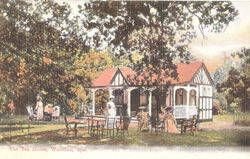
Opened during the height of Edwardian England, this charming venue quickly became a favoured destination for visitors, offering refined teas served in exquisite violet-patterned china. Guests were also invited to browse the lending library and explore a tasteful Fancy Goods shop showcasing the delicate embroidery of the Misses Williams.
Miss Florence Williams
 |  |  |  |  |
|---|---|---|---|---|
 |  |

Each year, the Williams sisters travelled from their family home in London to manage the Tea House for the season, and in 1913, it was reported that they had purchased it outright, although they were still designated as "leaseholders" in the 1921 sale of the Petwood estate.
Featuring a picturesque wooden veranda, rustic tables set on the lawns, and a serene path behind the Tea House adjacent to the stream, visitors were encouraged to unwind and appreciate the beauty of the Petwood estate grounds.
Miss Gladys Williams
Remember the time ?
The first transatlantic radio broadcast took place
-
Introduction of Number Plates for the first time in Britain,
along with a speed limit of 20 miles per hour.
-
The title of Prime Minister of the United Kingdom was officially
recognized by King Edward VII
-
1908 Summer Olympics: The Summer Olympics were held at the White City Stadium in London, where Great Britain and Ireland won a total of 56 gold, 51 silver, and 39 bronze medals.
-
1909 The Selfridges department store opened in London.
-
The census was conducted in 1911, revealing that one in seven employed persons was a domestic servant.
-
1912 Sinking of the Titanic, struck an iceberg on its maiden voyage from Southampton to New York City, resulting in the loss of over 1,500 lives.
-
Outbreak of World War I: Following the assassination, Austria-Hungary declared war on Serbia on July 28, 1914. This conflict quickly escalated as alliances were activated, leading to a war involving many of the world's great powers, including Germany, Russia, France, and Britain.
-
Easter Rising in Ireland: One of the most notable events was the Easter Rising in April 1916, where Irish republicans launched an armed insurrection against British rule in Ireland.
-
Treaty of Versailles: Signed on June 28, 1919, this treaty officially ended World War I. It imposed heavy reparations and territorial losses on Germany, redrawing borders in Europe and establishing the League of Nations to promote peace.
-
Establishment of the League of Nations: On January 16, 1920, the League of Nations held its first Executive Council meeting. This organization was created to promote peace and cooperation among countries following World War I, although it ultimately struggled to prevent future conflicts.